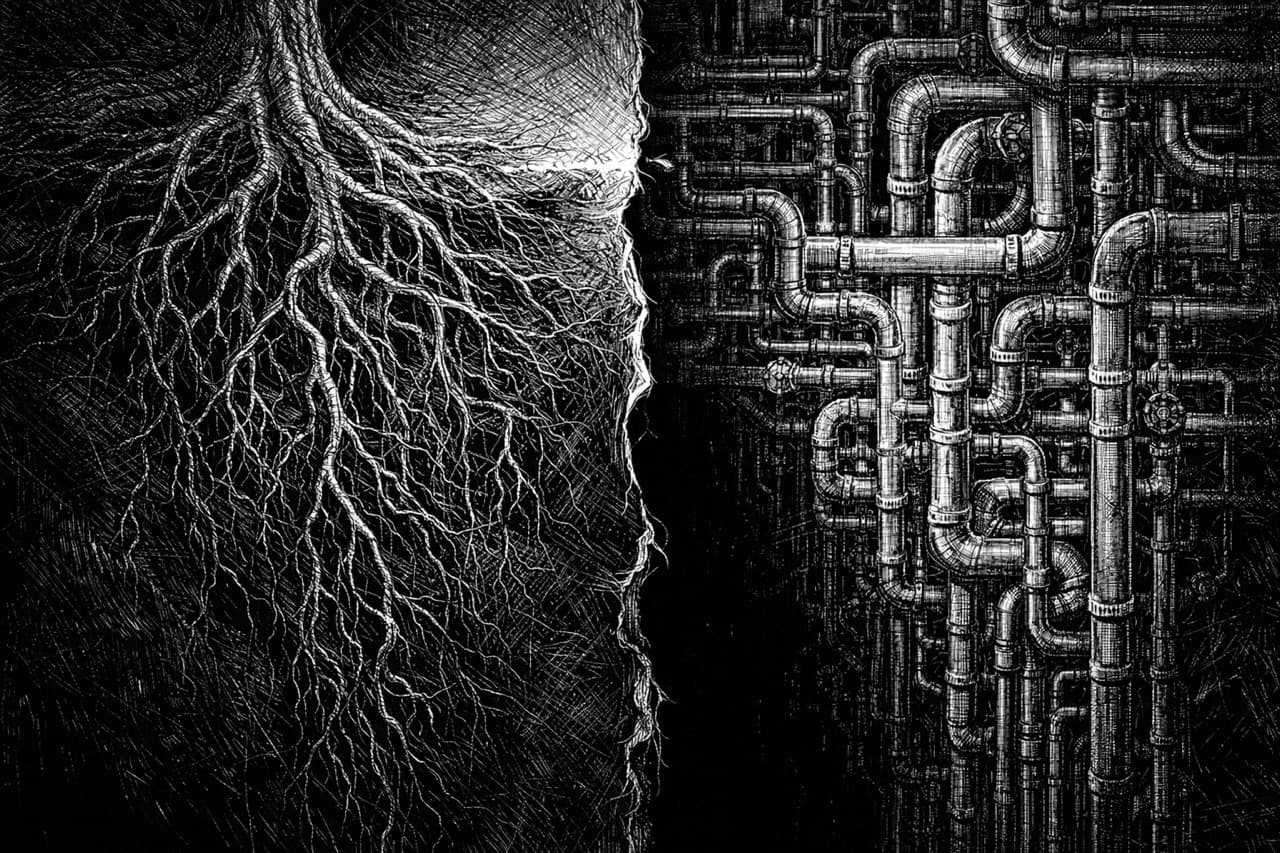
Greg Isenberg declares the Skill Era of the Internet, in which the winners won't own the pipes, they'll own the patterns. Encoded judgment. Expertise as infrastructure. A tight repo and a handful of skill files sitting inside thousands of agent workflows, shaping decisions at scale.
It's a good frame. The observation that LLMs compress execution — that a prompt can now approximate what used to require a dedicated integration — is real, and the instinct to ask "so what do I actually own now?" is the right question.
The answer he lands on, though, confuses the credibility of his examples with the credibility of his argument.
Stripe didn't win because it owned the payment pipe. It won because its pipe was accountable — PCI compliant, bank-regulated, contractually trusted, with ten years of edge-case handling baked in. A failed payment at 0.1% is a company crisis. A skill file that gives subtly wrong advice about landing page structure is a Tuesday. These are not equivalent forms of infrastructure, and calling them both "pipes" papers over the only thing that mattered about the original ones.
The scaling story has the same problem. "One installation, hundreds of companies, thousands of invocations" assumes encoding judgment is the hard part. It isn't. Good judgment is contextual — and a skill file, by definition, is the part that got compressed into something generic enough to package. What scales is the averaged version. The actually-good version is still the consultant on the call.
There's also a quiet distribution problem the post waves past in a single sentence: "a founder opens Claude Code and types /seo-audit." Yes — if your skill is already there. Getting it there is the entire unsolved problem. In the API era, that was docs, SDKs, and developer evangelism. The post treats the equivalent in the skill era as obvious. It isn't.
The real insight is worth holding onto: expertise that can be made composable and callable has structural advantages in an agent-heavy workflow. That's true and underappreciated, and the people building in that direction are thinking about the right things.
But "own the patterns" is not a moat. It's a metaphor. Patterns, unlike pipes, can be copied in an afternoon.
Welcome to the Skill Era. Bring your lawyers.
Stay current weekly
Get new commentary and weekly AI updates in the AI Primer Briefing.